
Reaching a difficult location is often the first challenge in treating it. Inside the small intestine, that challenge involves navigating a long, tightly folded passage with a slippery, delicate lining. A new soft robotic prototype offers a possible way to bring cameras and medical tools deeper into this demanding environment.
Called BIOSENTER, the device was developed by researchers at MIT and UT Southwestern Medical Center. Their study, published in Science Robotics on October 28, describes a robot that combines flexible movement, controlled steering, and surfaces designed to grip intestinal tissue.
The research remains preclinical. Its demonstrations establish capabilities in experimental settings, while further development and validation are needed before human testing.
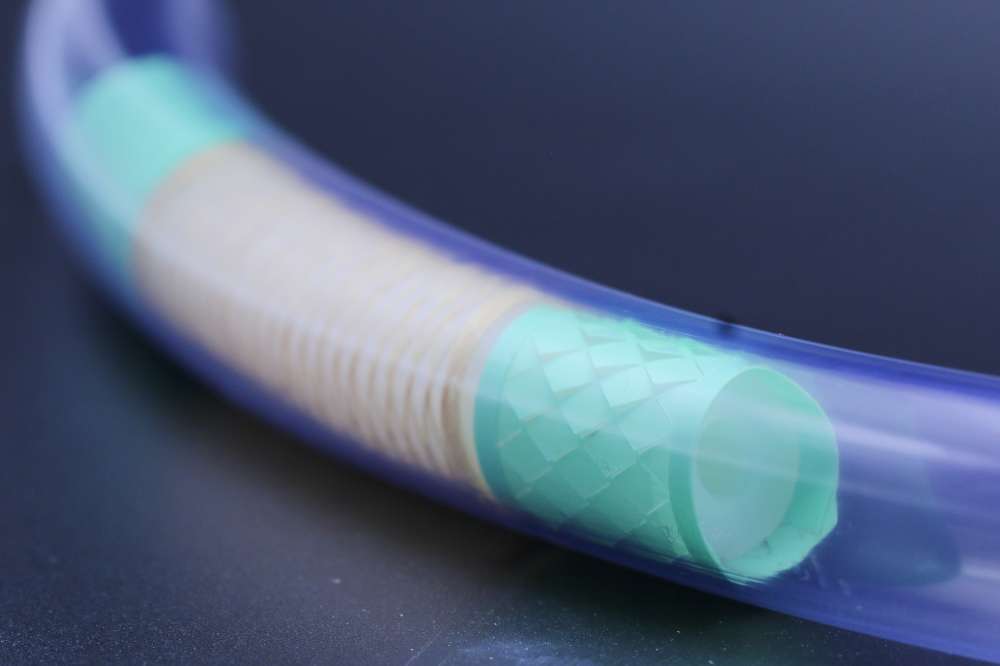
The robot borrows two ideas from nature: the bending movement of a snake and the traction provided by its scales. Air-filled chambers allow its body to extend and bend. By changing which chambers inflate, an operator can adjust its direction.
At the front and rear, expandable balloons carry patterned sleeves inspired by kirigami, the art of cutting and folding paper. As the balloons expand, small structures rise from the sleeves’ surfaces, increasing traction against the slippery lining.
These anchoring sections work in sequence to help the device advance. A cable connects the robot to external equipment, and an operator guides it using a controller. Fully autonomous navigation remains a future ambition.
The prototype also has a central channel for instruments. In preclinical testing, researchers demonstrated imaging, tissue biopsy, and localized fluid delivery while navigating approximately six feet of intestine in about eleven minutes. They reported no visible tissue damage during those tests.
That observation is encouraging, but it does not establish safety across the range of conditions encountered in patients. Longer-distance operation, usability, and direct comparisons with current double-balloon enteroscopy remain among the evaluations needed.
Double-balloon enteroscopy already allows clinicians to examine and treat the small intestine. However, operating the equipment requires specialized training, and procedures can be time-consuming. BIOSENTER’s developers hope their approach could eventually make navigation easier and reduce the demands placed on operators.
The technological significance lies in bringing movement and useful intervention together. Reaching a location with a camera provides information. Reaching it while carrying instruments creates possibilities for collecting samples or delivering treatment during the same procedure.
This also illustrates why soft robotics attracts interest in medicine. A device’s flexibility, surface texture, and method of anchoring can be as important as its motors or software. Here, the researchers are engineering how the robot interacts physically with its surroundings.
Turning the prototype into a practical clinical tool will require evidence that it performs consistently and can be integrated into medical workflows. The current achievement is a working demonstration that connects locomotion, steering, and instrument delivery in one experimental system.
If further testing supports the approach, BIOSENTER could give clinicians another way to reach areas that remain difficult to examine and show how carefully designed flexible machines can expand the possibilities of medical instrumentation.