
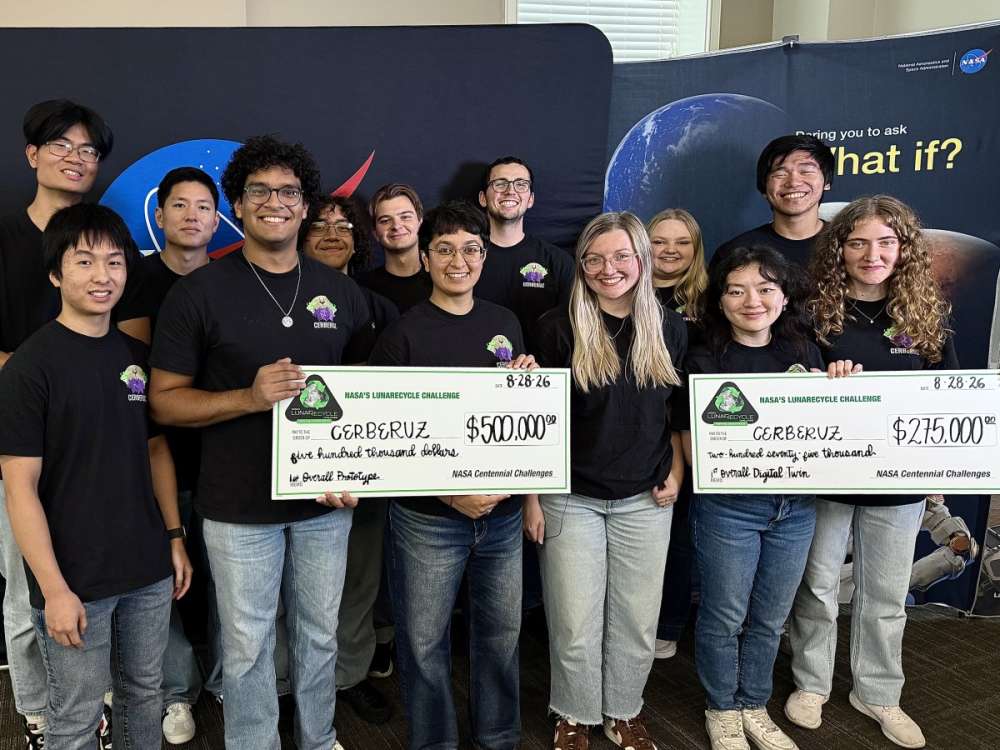
A future Moon base will need more than spacecraft, habitats, and reliable electricity. It will also need a practical way to handle the packaging and discarded materials that arrive with every shipment. An MIT student team has developed a recycling system that could turn some of that waste into material for useful parts.
The project, called CERBERUZ, won first prize in both the Prototype and Digital Twin tracks of NASA’s LunaRecycle Challenge. NASA announced the Phase 2 results in August, and MIT published a detailed account of the technology on October 20.
The system grinds mixed waste into powder and uses the resulting material as manufacturing feedstock. One notable feature is its treatment of Zotek foam, an aerospace packaging material: the team incorporates it as reinforcement instead of treating it only as contamination that must be removed.
NASA’s challenge encouraged technologies for recycling common non-biological materials, including plastics, fabrics, foam, and metals. The competition brought physical prototypes and virtual models together, allowing teams to demonstrate both their hardware and their understanding of how it operates.
CERBERUZ’s process uses thermoplastics as a binding material. After grinding and mixing, the plastic melts while other particles remain suspended within it. An injection-molding machine then pushes the mixture into a mold to form a composite part.
The team designed the approach around constraints that would matter far from Earth. It relies on electrically powered mechanical processing rather than water-intensive recycling or chemical depolymerization. That could make it attractive where water, replacement chemicals, and storage space are limited.
Alongside the equipment, the students developed a digital twin called DEIMOS. Using information from production runs, it models how different mixtures and part shapes behave during manufacturing, including risks such as incomplete filling, warping, and shrinkage.
The intended benefit is to help operators assess a manufacturing choice before spending scarce material and energy on a physical attempt. These capabilities have been developed and demonstrated on Earth; the system has not been deployed at a lunar outpost.
The broader engineering idea is compelling: a supply shipment could provide both its original contents and raw material for later use. Packaging would become a resource to evaluate, rather than simply something to store or discard.
Making that useful in practice requires careful decisions. A recycled holder or simple workshop accessory has different requirements from a component whose failure could endanger a mission. Material consistency, repeatability, and testing would determine which applications are appropriate.
The project illustrates why sustainability and exploration increasingly overlap. When resupply is difficult, recovering value from existing materials can become part of a mission’s basic operating strategy.