
The next major advance in exploring Mars could come from changing the shape of a helicopter blade. Researchers are investigating thinner, sharper rotor designs that could help future aircraft travel farther while carrying scientific instruments across the planet.
An October 20 research update describes work by NASA’s Ames Research Center, Imperial College London, and Nagoya University on an experimental blade profile called roamx-0201. The team used computer simulations to develop its unusual shape, then investigated its performance through wind tunnel testing.
Simulations suggest that a future helicopter using the design could potentially cover as much as 18.7 kilometres in one uninterrupted flight, compared with approximately 0.7 kilometres achieved by Ingenuity. That figure is a research projection, dependent on the aircraft and operating conditions. No helicopter has demonstrated that range on Mars.
The new profile also showed improved behaviour near stall, a condition in which changing airflow can sharply reduce lift. These results could help engineers expand the conditions in which future helicopters operate safely. The technology remains under development, with further work needed to reconcile predictions and experimental measurements.
Flying on Mars presents a difficult combination of challenges. Its atmosphere is only about one percent as dense as Earth’s, leaving rotor blades relatively few molecules to push against. Producing useful lift requires large blades, rapid rotation, and careful aerodynamic design.
Another constraint is the speed of sound, which is lower in the Martian atmosphere. As spinning blade tips approach that speed, airflow becomes more complicated and performance can deteriorate.
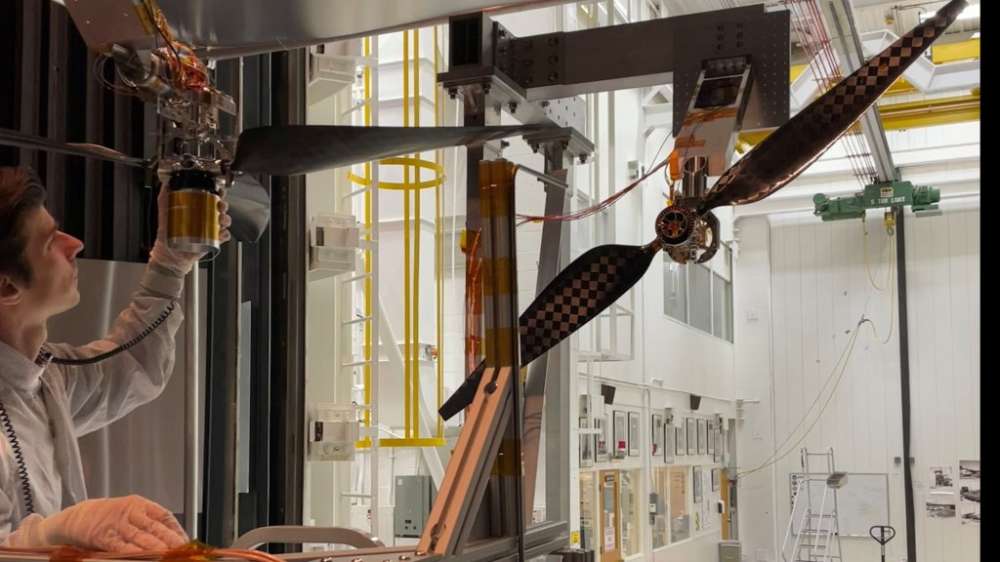
Separate tests at NASA’s Jet Propulsion Laboratory explored how future rotors withstand those demanding conditions. In results announced in May, engineers reported pushing rotor tips to Mach 1.08 inside a chamber simulating the Martian atmosphere. The blades remained intact. Across 137 test runs, researchers gathered information to guide designs intended to carry heavier scientific payloads.
The two research efforts address related questions: how to shape a blade efficiently, and how fast a rotor can operate reliably. Their results should not be combined into a claim that one finished aircraft has already demonstrated every capability.
For planetary exploration, greater flight range could change how a mission plans its observations. An aircraft able to cover more ground could inspect separated locations during a single trip, offering researchers more choices about where to collect information.
Carrying instruments also changes the helicopter’s role. Instead of serving primarily as a flight demonstration, it could become a platform for measurements that complement observations from orbit and investigations on the surface.
Reaching that stage requires more than a promising blade. Engineers must balance propulsion, batteries, structural strength, navigation, communications, and the demands of repeated landings.
The broader lesson is that exploration advances through improvements to individual components as well as entirely new spacecraft. A carefully redesigned rotor blade could eventually help turn brief flights above Mars into longer journeys with greater scientific value.