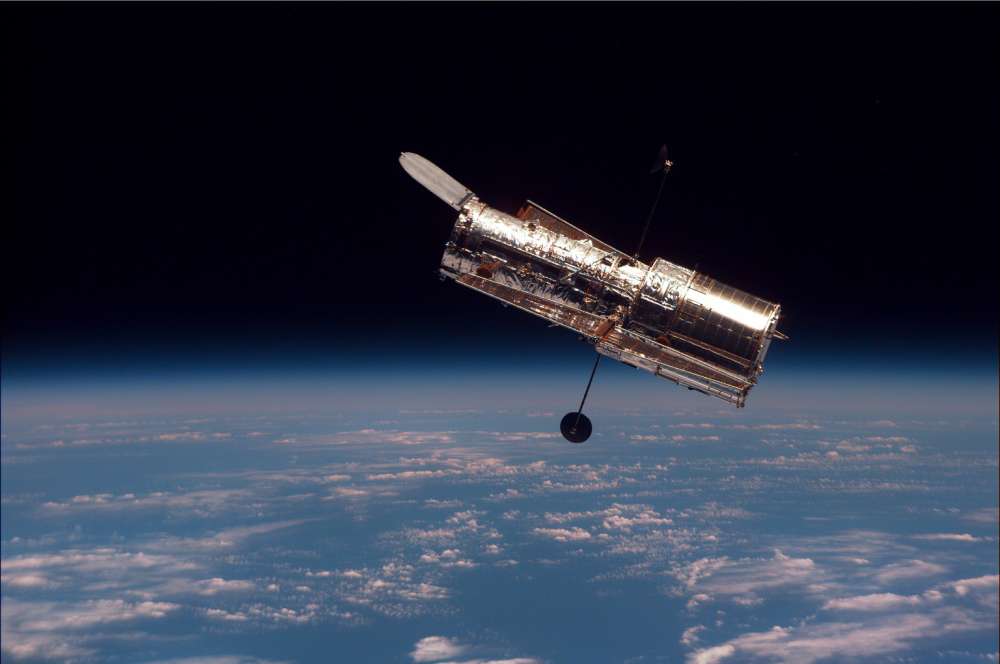
One of astronomy’s most productive instruments could gain a longer working life through a commercial servicing mission. NASA is asking companies how they might raise the Hubble Space Telescope’s orbit, improve its capabilities, or help manage its eventual retirement.
The agency issued a Request for Information on October 29 and announced the effort publicly on October 30. It is gathering information about industry capabilities, rather than announcing an approved mission, selecting a spacecraft, or awarding a servicing contract.
The request covers several possibilities. A visiting spacecraft could potentially boost Hubble to a higher altitude, extending the time available for scientific observations. Other concepts could involve servicing the telescope or conducting a controlled atmospheric re-entry or another disposal operation when its mission ends.
The timing matters because Hubble’s orbit is gradually declining. Although the atmosphere is extremely thin at its altitude, atmospheric drag slowly reduces its orbital energy. Hubble has no propulsion system to maintain its own orbit.
Current analysis places its likely atmospheric re-entry around 2033 or 2034. NASA therefore anticipates that a visiting mission would need to occur by 2032. Those dates are planning estimates, not a fixed countdown.
Companies have until November 30 to respond to the request. Their submissions will help clarify which approaches might be technically practical and financially reasonable.
The initiative reflects a broader change in how spacecraft could be operated. Traditionally, many satellites have been launched as complete systems with limited options for repair or upgrades. In-space servicing introduces the possibility of maintaining valuable equipment after launch.
That field already includes physical hardware at different stages of maturity. In an October 29 update, NASA described its latest assessment of in-space servicing, assembly, and manufacturing capabilities. The assessment covers areas such as robotic manipulation, refuelling, and structural assembly.
Its inclusion criteria require hardware to exist as a ground prototype or flight demonstration. That distinction is important: an experimental system on Earth and equipment proven in orbit represent different levels of readiness.
For Hubble, the engineering challenge would extend beyond simply reaching the telescope. Any proposed approach would need to address safe proximity operations, interaction with the spacecraft, and protection of its scientific capabilities.
Raising an orbit would also address only part of the challenge of extending a mission. The condition of the telescope’s instruments and supporting systems would remain important to its future performance.
Nevertheless, the potential value is substantial. Keeping an existing scientific observatory productive could preserve opportunities for discovery while engineers develop future instruments.
Hubble’s case illustrates why satellite servicing attracts growing interest. Spacecraft represent years of engineering, launch investment, and operational experience. Learning when and how to maintain them could change decisions about replacement, upgrades, and retirement across the space industry.
For now, the next step is assessment. Commercial proposals will help determine whether Hubble’s future could include another intervention—and what such a mission would realistically require.