Date: Sep 29, 2026
Technology & Innovation Desk
September 2026
Technology is entering a new phase.
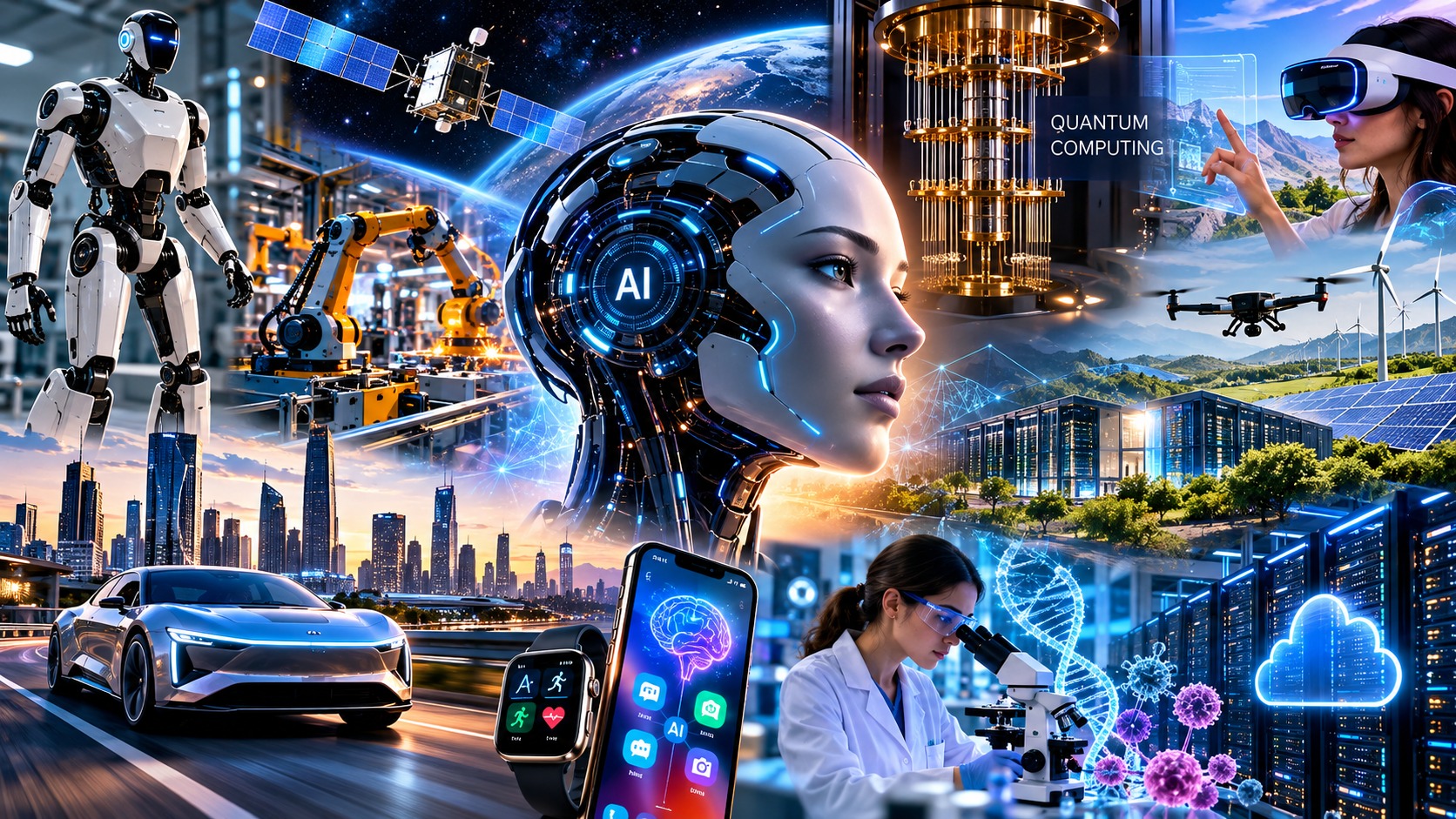
For decades, many of the biggest technological breakthroughs happened primarily on computer screens. In 2026, that is changing. Artificial intelligence is moving into robots, vehicles, factories, scientific laboratories, healthcare systems, energy infrastructure, and even space.
The biggest story is no longer simply that computers are becoming more powerful. It is that machines are increasingly capable of understanding, reasoning, learning, communicating, and taking action in the physical world.
Researchers and technology companies are simultaneously advancing artificial intelligence, robotics, quantum computing, semiconductor technology, cybersecurity, electric vehicles, biotechnology, spatial computing, and space-based computing. McKinsey's 2026 technology outlook describes this shift as technology moving increasingly from the digital world into the physical world.
Here are some of the technologies defining this new era.
Artificial intelligence remains the most important technology trend of 2026.
The first generation of generative AI primarily answered questions, generated text, created images, wrote code, and summarized information. The next generation is increasingly designed to perform tasks.
These systems are often called AI agents or agentic AI.
Instead of simply responding to a request, an AI agent can potentially break a complicated objective into multiple steps, use software tools, analyze information, make decisions within defined limits, and complete workflows.
For example, instead of asking an AI to create a spreadsheet, a future business system could potentially:
Collect information from multiple sources
Analyze the data
Build the spreadsheet
Identify unusual results
Create charts
Prepare a report
Send the finished document to the appropriate people
IEEE identified AI agents as one of its major technology predictions for 2026, particularly because of their potential to automate repetitive business activities. Gartner likewise lists multiagent systems and AI-native development among its major strategic technology trends for 2026.
The evolution is moving beyond text.
AI systems are increasingly being connected to cameras, sensors, software, robots, vehicles, and physical environments.
This creates what is increasingly known as physical AI.
The goal is not merely for AI to understand the world, but to interact with it.
One of the most visible developments in technology is the rapid advancement of humanoid robots.
Modern humanoid robots are being designed to walk, manipulate objects, navigate environments, interact with people, and perform repetitive physical tasks.
The technology is particularly attractive for warehouses, manufacturing facilities, logistics operations, and other environments where companies want flexible automation.
In September 2026, Agility Robotics introduced Digit 5, its next-generation humanoid robot. The company says the robot is designed to work around people without traditional physical safety barriers and is targeting manufacturing, warehousing, and distribution applications.
Qualcomm is also developing computing platforms specifically designed to give robots the processing power required for perception, planning, decision-making, and interaction. Its 2026 robotics platform is aimed at applications ranging from autonomous mobile robots to full-size humanoids.
The important development is the combination of:
AI + cameras + sensors + robotics + powerful processors.
Together, these technologies could create machines capable of adapting to environments instead of simply repeating one pre-programmed movement.
Behind almost every major AI system is a semiconductor.
AI requires enormous amounts of computing power, which has created massive demand for specialized processors.
Traditional CPUs remain important, but GPUs and specialized AI accelerators are becoming increasingly important for training and running advanced models.
The industry is also exploring new approaches to computing, including:
Specialized AI accelerators
Advanced packaging
Chiplet architectures
High-bandwidth memory
Photonic computing
More efficient power semiconductors
Photonic technology is particularly interesting because it uses light to move information. Researchers and companies are exploring optical interconnects as a way to address the enormous energy and bandwidth requirements of modern AI data centers.
This matters because AI isn't just a software revolution.
It is also a hardware revolution.
Quantum computing represents a fundamentally different approach to computation.
Traditional computers use bits represented by 0s and 1s. Quantum computers use quantum bits, or qubits, which can exploit quantum mechanical properties to process certain problems in fundamentally different ways.
The technology is still developing, but 2026 has seen continued investment in making quantum systems more useful and reliable.
Google announced in March 2026 that its Quantum AI program was expanding its research to neutral-atom quantum computing, alongside its superconducting approach. Google also said it expects commercially relevant quantum computers to become possible by the end of the decade.
In September 2026, the U.S. Department of Energy announced the Quantum Genesis Q Competition, with up to $215 million in planned funding aimed at accelerating the development of fault-tolerant quantum computers.
Potential applications include:
Drug discovery
Materials science
Chemistry
Optimization
Cryptography
Scientific simulation
Advanced financial modeling
Quantum computing is not expected to replace ordinary computers. Instead, its potential lies in solving certain specialized problems that are extremely difficult for classical machines.
The smartphone remains one of the most important consumer technologies, but its role is changing.
Instead of simply adding faster processors and better cameras, manufacturers are increasingly integrating AI directly into devices.
This is creating the era of the AI smartphone.
Future devices can increasingly perform tasks such as:
Real-time translation
Voice assistance
Image enhancement
Personalized recommendations
On-device summarization
Intelligent photography
Context-aware assistance
AI-powered productivity
Another important change is that more AI processing can occur directly on the device rather than always sending information to a cloud server.
This can improve:
speed, privacy, reliability, and offline functionality.
The smartphone is gradually becoming less like a traditional telephone and more like a personal AI computer.
Smartwatches and other wearable devices are also evolving.
Instead of simply counting steps and displaying notifications, modern wearables increasingly use sensors to understand aspects of the user's activity and environment.
Future wearable systems may combine:
AI assistants
Cameras
microphones
biometric sensors
health-related measurements
augmented reality
real-time translation
This could eventually reduce the need to constantly look at a smartphone.
Instead, information could appear through glasses, earbuds, watches, or other wearable interfaces.
Virtual reality places users inside digital environments.
Augmented reality overlays digital information onto the physical world.
The broader concept of spatial computing attempts to combine the physical and digital worlds.
Instead of interacting with a computer through a traditional flat screen, users can interact with digital objects in three-dimensional space.
Potential applications include:
Education
Engineering
Medicine
Gaming
Architecture
Remote collaboration
Industrial maintenance
Training
Imagine an engineer wearing spatial-computing glasses and seeing a digital model of a machine directly over the real equipment.
Instead of reading a manual, the system could show the worker exactly where a component belongs.
Electric vehicles are transforming more than the powertrain.
Modern EVs increasingly resemble computers on wheels.
They combine:
Electric motors
Large battery systems
Advanced sensors
Powerful onboard computers
Software-controlled systems
Connectivity
Driver-assistance technologies
Another major development is the increasing use of silicon-carbide and gallium-nitride semiconductor technologies in high-power applications.
These materials can help improve power conversion efficiency and are relevant to EVs, data centers, industrial systems, and renewable-energy infrastructure.
At the same time, autonomous-driving research continues to push vehicles toward greater levels of automated perception and decision-making.
As AI becomes more powerful, cybersecurity becomes even more important.
Attackers can potentially use AI to automate reconnaissance, generate convincing social-engineering messages, analyze vulnerabilities, and scale attacks.
Defenders are responding with AI-based security systems capable of monitoring enormous amounts of activity and identifying suspicious behavior.
This is creating a new cybersecurity environment where:
AI can attack systems, and AI can defend systems.
Another important area is confidential computing, which aims to protect sensitive information while it is being processed.
As companies increasingly use cloud computing and AI systems, protecting data becomes just as important as processing it.
One of the most interesting developments is the combination of artificial intelligence with biology.
AI can analyze enormous biological datasets and help researchers identify patterns that would be difficult to discover manually.
Potential applications include:
Drug discovery
Protein design
Genetic research
Medical imaging
Personalized medicine
Biotechnology
New materials
IEEE's 2026 technology predictions highlighted adaptive bio-AI interfaces as an emerging area, where systems could continuously interpret biological signals and potentially support real-time therapeutic adjustments.
This represents a broader trend:
AI is becoming a scientific research tool, not just a productivity tool.
There is a problem behind the AI revolution:
AI requires enormous amounts of electricity.
Data centers need power not only to run processors but also to operate cooling systems and supporting infrastructure.
As AI adoption grows, technology companies and governments are therefore becoming increasingly interested in:
Nuclear energy
Solar power
Battery storage
Advanced power grids
More efficient chips
AI-controlled energy systems
New cooling technologies
The relationship between AI and energy is becoming one of the defining technological challenges of this decade.
The future of AI will depend not only on better algorithms but also on whether the world can provide enough affordable and reliable electricity to run them.
Traditional data centers primarily stored information and hosted applications.
Modern AI data centers are increasingly becoming massive computational factories.
They contain enormous clusters of:
AI accelerators
CPUs
High-bandwidth memory
Networking equipment
Storage
Cooling systems
Power-management equipment
The physical infrastructure required to operate these facilities is becoming just as important as the AI models themselves.
This is why semiconductor manufacturing, networking, power generation, cooling technology, and data-center construction are becoming increasingly connected to the AI economy.
One of the most futuristic developments is the idea of putting AI computing infrastructure in orbit.
In September 2026, Google announced plans to test AI chips in space as part of Project Suncatcher.
The planned prototype satellite will carry Google's Tensor Processing Units to evaluate how AI hardware performs under space conditions, including radiation, extreme temperatures, and launch forces.
The long-term concept is ambitious:
solar-powered computing infrastructure in orbit.
Space receives continuous sunlight in many orbital configurations, potentially creating an interesting environment for energy-intensive computation.
However, significant challenges remain, including launch costs, radiation, cooling, communications, maintenance, and reliability.
Software development is also undergoing a major transformation.
AI coding systems can already help developers:
Write code
Explain code
Find bugs
Generate tests
Refactor applications
Create documentation
Build prototypes
The next step is AI-native software development, where developers increasingly describe what they want and AI systems generate significant portions of the implementation.
This does not necessarily eliminate programmers.
Instead, it changes the programmer's role.
Developers may spend less time typing individual lines of code and more time designing systems, reviewing AI-generated code, testing software, managing architecture, and solving complex problems.
Perhaps the biggest technological shift of 2026 can be summarized in two words:
For years, AI primarily existed inside computers.
Now it is being connected to:
robots + vehicles + drones + factories + cameras + machines + satellites.
This allows artificial intelligence to interact with the physical world.
The technology industry is increasingly treating physical AI as a major strategic direction. Gartner lists physical AI among its top strategic technology trends for 2026, while major semiconductor companies are developing processors specifically designed for robotics and autonomous systems.
This could eventually lead to intelligent machines that can perform tasks in homes, warehouses, hospitals, farms, construction sites, and factories.
The most important technology developments of the next decade may not be individual products.
They may be the combination of technologies.
Imagine:
AI + robotics + advanced chips + batteries + sensors + cloud computing + quantum computing + biotechnology.
Each technology is powerful on its own.
Together, they could create systems that are dramatically more capable than today's technology.
A robot could use AI to understand an environment, advanced sensors to perceive objects, specialized chips to process information, cloud systems to access additional intelligence, and electric batteries to operate independently.
That is fundamentally different from traditional automation.
The technology revolution of 2026 is not happening in one industry.
It is happening everywhere.
Artificial intelligence is becoming more autonomous. Robots are becoming more capable. Chips are becoming more specialized. Quantum computing is moving toward practical applications. Vehicles are becoming software platforms. Wearables are becoming more intelligent. Biotechnology is merging with AI. Data centers are becoming enormous computational infrastructures. And companies are even beginning to experiment with putting AI computing hardware in space.
The defining characteristic of this new era is convergence.
The future will not be powered by AI alone.
It will be powered by the combination of AI, robotics, advanced computing, energy, biotechnology, communications, and automation.
The biggest question is no longer whether technology will change the world.
It is how quickly these technologies will move from laboratories and prototypes into everyday life.
And in 2026, that transition is already underway.