
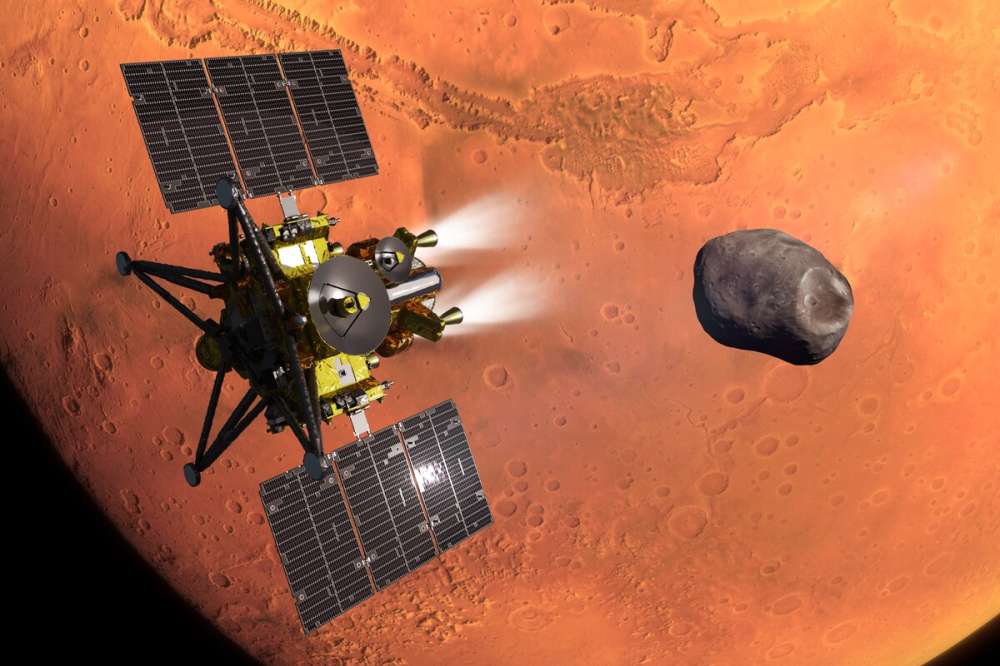
A spacecraft preparing to explore Mars’s two moons could help answer a question that has puzzled scientists for decades: where did these small, unusual worlds come from? Japan’s Martian Moons eXploration mission, known as MMX, aims to investigate Phobos and Deimos and return material from Phobos to Earth.
The mission represents an ambitious step in robotic exploration. Rather than relying only on photographs and measurements from a distance, MMX is designed to collect physical samples that scientists can examine using laboratory equipment on Earth. JAXA, Japan’s space agency, plans to retrieve at least 10 grams of material during the mission.
That may sound like a small amount, but carefully collected grains can preserve evidence about a celestial body’s composition and history. Returning material also allows researchers to revisit samples as scientific instruments and analytical methods improve. The mission’s value could therefore extend well beyond the spacecraft’s journey.
One central mystery is whether Phobos and Deimos began as asteroids captured by Mars or formed from debris following a major impact. Studying their composition could help researchers distinguish between these explanations and better understand the early history of the Martian system.
NASA is contributing scientific instruments, sampling technology, and communications support. Its MEGANE instrument, developed by the Johns Hopkins Applied Physics Laboratory, will measure gamma rays and neutrons emitted from Phobos. These measurements will help identify the elements present on the moon’s surface, adding chemical information to the mission’s visual observations.
This combination of measurements matters. Images show the appearance and structure of a landscape, while chemical observations help reveal what that landscape contains. Together, these data can provide context for the samples eventually brought home.
MEGANE’s observations will also support the selection of sampling locations. Choosing where to collect material requires more than finding a convenient patch of ground: scientists need to understand how a location fits into the wider surface and what its samples might reveal. JAXA’s sampling equipment includes a robotic arm and a cylindrical corer designed to collect material beneath the surface.
According to NASA’s October 15 update, MMX is targeting launch on October 19, 2026, in the United States, corresponding to October 20 in Japan. Arrival at Mars is planned for August 2027, with samples expected to reach Earth in 2031. These remain mission targets, and the spacecraft has not yet returned any material.
MMX illustrates how exploration is evolving: robots can gather evidence from distant destinations and deliver it to laboratories where generations of researchers can study it. If successful, the mission could turn a handful of extraterrestrial grains into a much clearer picture of how Mars’s moons formed.